“My Name is Absalom” Part 2 by P.M. Gilmer

Here is part two of my continuing story. If you missed part one, please click on following link:

https://declaretonextgeneration.com/2017/07/28/my-name-is-absalom-part-1/
 

Now I come to the part of my story which is the most difficult for me to tell, but, unfortunately, it is the most important and explains how and why things changed so much between myself and my brothers.

I had spent the morning idling at my house, knowing I should make my way to the palace to see my mother. I was expected for dinner that evening, but I hadn’t spoken to her since we returned from battle several days ago now, and I knew my mother would be annoyed that I had made no effort to see her on my own. Before I could summon the energy to get ready to go, one of my servants entered my room, his eyes wide with fear.

“My lord! There is trouble outside! Your sister . . .”

When my servant first entered, I sighed, ready to rebuke him for troubling me about some minor disaster, but as soon as he uttered the words “your sister”–I sprang to my feet, pushed him out of the way, and ran out the door.

Just down the street from my house, I could see a small crowd gathered and could hear the wailing of a young woman–a young woman whose voice I recognized very well.

Not bothering to put on sandals or even an outer garment, I dashed down the street, kicking up dust, and upon reaching the crowd, pushed the first man out of my way. I gasped as I saw my sister standing in the middle of the street, wearing the new, colorful robe our father had recently given her. But, the robe was torn and ashes covered her beautiful hair. Her maidservant cowered next to her, tears streaming down her face as well.

I cannot express the horror I felt upon seeing my sister in such a state. For a moment, I could not move. Then I looked up and over the crowd and realized where we were standing–right outside my brother, Amnon’s house. In front of his door, two servants stood guard, their eyes wide with consternation and dismay, but also a fierce determination. I turned back to Tamar and grabbed her by the arm.

“Tamar! Be quiet! You’re making a spectacle of yourself! What is wrong? Has that Amnon been with you?”

She would not stop weeping, so I gave her a little shake. “Tamar! Be quiet! Amnon is your brother, so don’t take this to heart. I’m sure he didn’t mean to hurt you–but no matter what has happened–we need to keep this in our family.”

I began to pull her by the arm to bring her home with me and when she resisted, I looked into her eyes. The reproachful look she gave me pierced my very soul, but I still needed to get her out of the street. The crowd around us remained silent, not daring to speak or call out while I was there, but I knew as soon as I left, the talk would spread far and wide about the trouble between the children of the king.

Once we reached my house, I turned her over to one of my women servants who, along with Tamar’s own handmaid (who had followed us silently through the street) took off Tamar’s torn robe and led her off to bathe and comfort her.

While the women took care of Tamar, I paced through my house wanting to go and confront Amnon, but I knew the crowd would still be there, waiting to see what I would do. Though my first thought after realizing what must have happened between Amnon and Tamar had been to force Amnon to marry my sister, my thoughts now grew darker, and I knew I only wanted to kill him. I tried to calm myself, knowing I should go and speak with my father first, but I was in no mood to see him. I did not know what my father would do, but I knew he would not countenance any type of severe punishment. Certainly not the death I now envisioned in my mind.

In the end, I did nothing. Well, not right then anyway. I ordered a servant to bring me a skin of wine, and I took it and a cup up to my roof to drink. The sun was sinking into the horizon, and though the air quickly cooled, it did nothing to chill my blood.

I had drunk about half the skin when Tamar came up silently behind me and sat down on a bench next to me. We said nothing for several moments, just stared out at the darkening sky. Then, taking a deep breath, Tamar said in a shaky and low voice, “He said he would never marry me, and,” she stopped, trying to stifle a sob. “And he said he hated me.”

The rage I had been trying to tamp down flared up, and I hurled my cup out into the night. “He said that? He actually said that?”

Tamar nodded, her face down, sobs hiccupping out of her. “I tried to tell him to wait and ask Father to let us marry, but he wouldn’t listen. He just . . . just forced himself on me, then told me to get out. Said he hated even the sight of me and told his servant to throw me out and lock the door.”

Before I could respond, one of my servants came up to us, bowed to me, and said, “Sorry to interrupt, my lord, but your mother has sent a messenger wanting to know why you didn’t appear for dinner. I believe she is still waiting for you.”

I groaned but knew I should go. Obviously, I needed to talk to her anyway, but it would not be at a pleasant family meal. I stood up, then turned back to Tamar. “I need to go. She must not have heard about this yet, but she will soon enough. I will leave guards at the door, so you will be safe here. You will be fine?” I didn’t think she would actually be “fine”, but I had no choice but to leave. I needed to speak to both our mother and father, then decide how to take care of Amnon.

Tamar reached up and took my hand. “There is one more thing you should know,” she said, her voice so hoarse from her earlier screaming and crying I needed to strain to hear her. “Jonadab was there as well.”

My eyebrows raised and my gut clenched. “Jonadab? You mean?”

She shook her head. “No, not that he touched me, but he was there with us. He opened the door for me and brought me into Amnon. He . . .” Her voice broke again, and new suspicions crept into my mind.

“I don’t understand. Why were you there anyway?”

“Father sent me,” she said, her voice even lower.

I was so stunned, I sat back down. “Father sent you? What do you mean?”

“Father called me this morning. He had been to see Amnon because he was sick, and Amnon told Father he wanted me to come to him with food. So, I made some bread and brought it to him. When I got there, Jonadab was waiting for me. Like I said, he brought me into Amnon’s room and as soon as I went in, Amnon grabbed me. I tried to stop him . . .”

I pulled my sister to myself, hugging her tightly as she sobbed. “It’s not your fault,” I said fiercely. “Do not think that for a minute. And you do not have to marry that fool, Amnon, either. You can stay here with me. I will take care of everything. Do you understand?”

She nodded, her head against my chest, and I wished I did not have to leave. But, my mother was not a patient woman. Besides, I now had another reason to go: I needed to confront my father.


My Name is Absalom: Part 1 by P.M. Gilmer

“My Name is Absalom”–A Story Told in Seven Parts

My sister, Tamar, is the most important person in my life. That may sound strange, but let me explain about my family life.

My father, a king, has a multitude of wives and, consequently, an even greater multitude of children. I am the third of six sons born very close together and all with different mothers. We were like a litter of puppies growing up together. We played, fought, and made a competition of everything—who could run the fastest, climb the highest, shoot an arrow the farthest, etc. You get the idea. We all wanted our father’s attention and so did his wives. Our mothers did what they could do to attract our father’s attention, but they also didn’t mind using us boys to enhance their own standings with the king.

I wasn’t going to mention this, since I in no way want this to be about my father (more than enough has been written about him), but I might as well get it out of the way. My father is King David of Israel. Yes, that King David. Killed a giant with a sling and a stone when he was just a “boy” (I hardly consider seventeen the age of a boy, but I suppose it makes a better story); chosen among all his brothers to be king by God Himself, wrote a few million songs, and continues to be a mighty warrior. Rah, rah, rah.

My mother was and remains the most beautiful of the six women. No, really. My brothers and I actually discussed this quite often. We compared our mothers in many ways because we knew our father did as well. Part of that competition thing, I suppose. Besides being a beauty, my mother is the princess of a small country. So small few have heard of it, but she never lets anyone forget she is the daughter of a king. She believes the other wives are “common” compared to her, and, of course, she is right. They all grew up as daughters of shepherds or winemakers or soldiers. Nothing unusual or shameful in any of those, but my mother never let me or anyone else forget her upbringing was of a higher quality.

Anyway, that’s not to say the other mothers are ugly. By no means. Our father may have had poor judgment in many areas, but he certainly has good taste in women. However, my mother stood well above the others in beauty, which was just as well as I’m afraid it is her only redeeming attribute. Her intelligence is average at best, her charm non-existent, and her personality might best be described as abrasive. She has never been the type of mother a child could run to when hurt and expect comfort. Rebukes or reprimands were her most often used forms of communication with her children.

Which brings me to my sister. Tamar is eight years younger than me so I remember the day of her birth very well. I had not been happy my mother was expecting another child (and in truth, neither was she). I had been quite content to be her only son and I did not want another brother to draw my father’s attention and affection. So, when Tamar was born, I was as delighted she was a girl as my mother was disappointed. Though she did grow to adore her daughter (as much as she was capable), at the time, my mother was despondent believing (wrongly as it turns out) that her husband would not be pleased with the birth of a daughter.

Though at first I was just pleased Tamar was a girl, it didn’t take long for her big brown eyes to capture my heart and to bring out in me fiercely protective feelings. And unlike with my brothers, competition never existed between us. If our father or mother showed her any type of favor, it did not stir up envy in my heart as it did with my brothers but rather delight and pride. In fact, I’m sure I took more pride in her than did our father, and I certainly did more to care for her welfare.

As Tamar began to grow into a young woman, others started to take note of her. At first, this only increased my pride in her, but I soon realized the attention of others was not always a good thing, and I would need to do more to protect her and keep her safe. I also expected my brothers to help keep an eye on Tamar, as I would do the same for their sisters. Though we might fight and compete–when it came to our sisters, we were united in our protection and loyalty to them. Or so I always thought.

Looking back now, I can remember when things began to change for us all, but I didn’t see it at the time. Three of my brothers, our cousin Jonadab, and myself decided to spend the evening celebrating our return from battle with the Philistines. We had been away from Jerusalem almost three weeks and were giddy with our victories.

Jonadab, the son of one of my father’s brothers, often spent time carousing with us. Of my brothers: Amnon held the title of first-born, though closely followed by Chileab. I am the third born and Adonijah is my younger brother by less than a year. Amnon and Chileab, though close, were as different from each other as night and day. Truth be told, Amnon and I were much closer to each other as we both enjoyed the women and playing pranks on the others. Chileab could be a bit too serious for the rest of us, but he accompanied us that night. Probably to keep an eye on us more than anything. He was good about that, and though at times I found him annoying and pompous, he did keep me out of trouble more times than I deserved.

Anyway, it’s not so much what we did that night that’s important but rather something Amnon said as we made our drunken way home. With the exception of Chileab, we were bragging about the women we had met, how much we had impressed them, and which ones we wanted to meet with later. I was walking beside Adonijah with the other three behind us. Chileab had been so quiet, I almost forgot he was with us until I heard him rebuke Amnon sharply.

“Hush, fool. Just because you’re drunk is no reason to say such things.”

I stopped, and Amnon ran into the back of me. I turned to look at him. “What were you saying, Amnon? Is Chileab jealous because that luscious dark-haired woman so obviously wanted to come home with you? Or is he still mad because you killed more Philistines than him?”

Amnon gave me a crooked grin, then put a finger to his lips. “Shhh! It’s supposed to be a secret!”

I laughed raucously, thinking I was right especially considering the grievous look Chileab gave me.

Adonijah jabbed me in the ribs. “Hush! You’ll wake the neighbors, and they’ll complain about us to Father.” Then he looked at Amnon suspiciously. “What’s a secret?”

The five of us stood in the middle of a dirt road, darkened houses on either side of us. Above us, the moon shimmered as only a sliver in a multitude of stars in the surrounding darkness. The only sounds to be heard were croaking frogs, night insects, the occasional hoot of an owl, and the heavy breathing of my companions.

Still grinning, Amnon started to speak when Chileab stopped him. “It’s nothing. He’s just drunk, more than usual it would seem. We need to get home.” He took Amnon by the arm and started walking him past us.

Amnon turned to look at me, then winked. “He doesn’t want you to know who I really love.”

Everything still seemed funny to me, so I continued laughing and hollered after him. “Who, Brother? Who do you love?”

His reply came back to me, carrying loudly through the night air. “Tamar! I love Tamar, your beautiful sister!”

I cringe now to remember how I continued to laugh. Jonadab put an arm around my shoulders and laughed as well. “Your oldest brother has good taste, Absalom. Tamar is turning into a beautiful young woman.”

“That she is,” I agreed proudly. “The most beautiful woman in Jerusalem. No, in all of Israel!”

We all laughed together and somehow made our way back to our own homes. I immediately went to bed, fell asleep, and did not see my brothers or cousin for several days. In fact, the next time I saw Amnon and Jonadab, I made plans to kill them both.


Characters & Spoilers

As a writing exercise for myself, I have been writing a section of my manuscript through the eyes of the antagonist, Absalom, rather than the protagonist, Solomon.

This exercise has been beneficial for helping me better understand that character. But, another reason has come to me and that is to share this story on my blog. Why? Well, I hope to make my blog more interesting and also to find readers who also enjoy reading historical fiction.

One danger in this type of sharing is the presence of spoilers for a future book. However, in writing historical fiction, one has an advantage in that spoilers already exist if a reader has any knowledge at all of the time and events being written about. For example, if a reader picks up a book about Anne Boleyn, that reader will probably not be surprised to learn that she marries King Henry VIII or that she eventually loses her head. However, a good writer will be able to draw the reader into the story so well that even when reaching a foregone conclusion, the reader will gasp in horror at Anne’s fate. I have read many books when this was the case. Even though I knew a certain character was going to die and even how that would happen, the empathy I had developed for the character caused me distress and sorrow for that character.

So, in reading this short story about Absalom, there may be spoilers for any future book, but if you have already read 2 Samuel, there will be no big surprises. Rather than spoilers, this story should put the character of Absalom in a clearer light that readers might see him more as a real person rather than just a “Bible character.”

Starting tomorrow I will begin posting the story, “My Name is Absalom.”  This will be the first of seven parts, and I will continue posting for the next six Fridays. I hope you enjoy it.

Crossing the Waters by Leslie Leyland Fields

What first grabbed me about Crossing the Waters is the subtitle: Following Jesus through the storms, the fish, the doubt, and the seas. Fields, originally from New Hampshire, married a fisherman in Alaska changing her life completely as they built a house on a small island, raised children and caught fish. Not sugar-coating anything, Fields shares her own struggles as a wife, mother, and a disciple of Jesus. She retells the stories of Jesus and the fishermen He called to be His disciples. Most of her experiences come from fishing in Alaska, but she also retraces Jesus’ steps around and on the Sea of Galilee.

Reading again of Jesus walking on the stormy water or waking from a deep sleep to calm the sea through the eyes of someone who has been on stormy waters, both literally and figuratively, gave me a new appreciation for the experiences of the disciples and the awesome power of our God.

Favorite quotes: “They are believing in their fear of the deep more than in Jesus. They do not yet know that he is with us wherever we are, that he will even walk on water in the middle of the night in a storm to come to us . . .”

“Jesus has not come to save them from the waters–death is not the enemy–but to save them from unbelief and their still small faith.”

Fields has written an enjoyable, thought-provoking book helping us to reconsider what Jesus meant when He said, “Come, follow me.” This is a book I highly recommend and am sure I will read again.


Book Review: “Then Sings My Soul” by Amy K. Sorrells

Nel Stewart hasn’t been home in years when her mother’s sudden death brings her back to Michigan from Arizona. Her father’s deep grief and oncoming dementia causes Nel to stay longer than she originally intended. Together, Nel and Jakob work through their present pain as well as learn to deal with their past griefs.

Using alternating story lines, Sorrells tells Jakob’s story of his escape from the Jewish pogroms in the Ukraine, a story Nel never knew. We also learn Nel’s story of why she left home and the significance of Jakob’s hobby of the lapidary arts.

I was immediately drawn into this book because of the historical descriptions of a time and place I know little about (the Ukraine and the Jewish pogroms). The use of the lapidary arts was also an interesting addition, giving insight to the characters–their backgrounds and their interests.

From the title, I thought it was going to be a book about the song, “How Great Thou Art”, but it’s not; exactly. The author explains the meaning behind the title at the end, so make sure you read that. Highly recommended!


First Lines

In editing and rewriting, I have struggled with those first lines. The first line on the first page is probably the most important as you are trying to reel readers in, but even the first line of succeeding chapters have a place of importance, and it seems to take me awhile to warm up to my subject or my scene. I am now going through several books and writing down their first lines. These lines are not necessarily famous or even great. In fact, most are so simple, I wonder if I am just trying too hard.

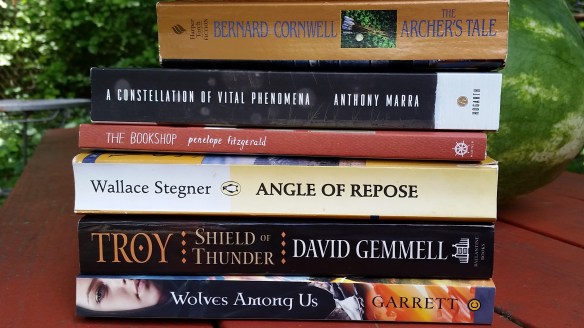
“Joshua Poldark died in March 1783.” Winston Graham in Ross Poldark

“The treasure of Hookton was stolen on Easter morning 1342.” Bernard Cornwell in The Archer’s Tale

“Roger woke and shot upright on a gulp of breath.” Elizabeth Chadwick in The Time of Singing

“A cold wind blew down from the snow-covered mountains, hissing through the narrow streets of Thebe Under Plakos.” David Gemmell in Troy Shield of Thunder

“Weeks had gone by since winter had lost her blinding white beauty.” Ginger Garrett in Wolves Among Us. (For those who say not to start with weather, these last two are rather beautiful to me.)

“Elizabeth Middleton, twenty-nine years old and unmarried, overly educated and excessively rational, knowing right from wrong and fancy from fact, woke in a nest of marten and fox pelts to the sight of an eagle circling overhead, and saw at once it could not be far to Paradise.” Sara Donati in Into the Wilderness  (Now, there’s a sentence! Excuse me, while I pause to reread this book.)

“In 1959 Florence Green occasionally passed a night when she was not absolutely sure whether she had slept or not.” Penelope Fitzgerald in The Bookshop

“On the morning after the Feds burned down her house and took her father, Havaa woke from dreams of sea anemones.” Anthony Maara in A Constellation of Vital Phenomena

“At dusk they pour from the sky.” Anthony Doerr in All the Light We Cannot See

“Now I believe they will leave me alone.” Wallace Stegner in Angle of Repose

This is rather fun, and I could keep going, but I have also found this exercise inspiring, so I need to cut this off and go read. I mean, write.

Biblical Fiction: Dead or Alive?

At the writers conference I attended in March, I had an opportunity to meet with someone who is the head of a Christian agency and well known in Christian publishing. I didn’t go with the plan of talking with him, so was pretty proud of myself for taking the plunge. I knew it would be a good experience, both to speak with him and to hear his thoughts on the book I’m writing. Now, I was not expecting much–no, I really didn’t think I would tell him about my story, he would respond with delight, and hand me a contract on the spot. The dream is there but I was feeling pretty realistic. However, I have spent a bit of time thinking over some of the things he said, and I have to admit, I am still puzzled by his attitude.

His first response to my pitch of “I’ve written an historical novel about Solomon growing up in King David’s palace,” was “People aren’t reading Biblical fiction. That just doesn’t sell, and no one is publishing it.”

I was stunned and, yes, I’m a bit of a slow thinker, so it wasn’t until I was back in my hotel room that I thought: “What about Tessa Afshar? Ginger Garrett? Connilyn Cossette? Francine Rivers? Jill Eileen Smith? Stephanie Landsem? Mesu Andrews? These writers may not be on the New York Times bestseller list, but they are all publishing Biblical fiction and doing reasonably well. I am currently reading Tessa Afshar’s Land of Silence, am enjoying it, and believe it is very well written. 

Did I misunderstand him? No, the conversation went on from there as he explained the ups and downs of Biblical fiction and told me why no one was interested in that any more. Of course, I tried to tell him that my book was special and many people would be interested in it and love to read it. Well, I didn’t exactly say all that, but I did spend more time telling him of my story, but I did not leave with a positive impression.

Looking through the authors I mentioned above, I found they were published by six different publishers, so there seems to be quite a few publishers still interested in these books.

So, am I wrong, and is he right? Are people not interested in reading Biblical fiction? What about you? Have you read any of these authors lately? Have you any others to add and recommend?

Kings Mountain National Military Park S.C.

I haven’t been blogging lately, but I have been writing. Still editing (trying to get that word count down that I worked so hard to build) and also working on a couple of short stories. Took a day to enjoy the spring sunshine during my son’s spring break and went to Kings Mountain. Besides being a nice place to take a not-too-strenuous hike (except for that little part when you’re going straight up the mountain but still piece of cake compared to its neighbor, Crowders Mountain), an important piece of American history took place there in 1780.

To sum: the Brits stirred up a hornets nest by threatening the Scots-Irish mountain men. The Patriots had lost several major battles, and Major Patrick Ferguson was sent to raise men for the loyalist cause in the Carolinas.  Sending a message to the leader of the “backwater men”, Ferguson riled the mountain men with his words that “he would march his army over the mountains, hang their leaders, and lay their country to waste with fire and sword,” if they did not desist from their opposition to British arms. With 900 of their best riflemen, the Patriots met Ferguson and his men on this mountain, and using their superior guerrilla tactics, defeated Ferguson and his men in little over an hour on October 7, 1780. This battle turned the tide of war in the Patriots’ favor which would eventually lead to their overall victory.

Memorial to the three African Americans who fought with the Patriots.


83 feet high, this monument was dedicated in 1909 with a list of those died in the battle.

The centennial monument dedicated on October 7, 1880.

In spite of his loss and death in this battle, Ferguson was honored for his service and is also known as the sharp-shooter who had an opportunity to shoot General George Washington, but out of a sense of honor did not.

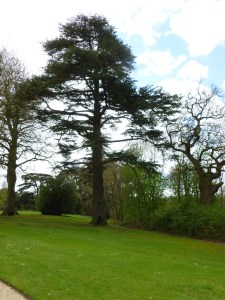
A tree that seems to be flaunting its individuality. (I enjoy finding unusual trees).