Christianity Today’s 2018 Book Awards

I subscribed to the magazine Christianity Today and one of the features I look forward to every year is their list of book awards. (No real surprise there). I invariably find, not only books I’ve never heard of, but also authors.  Not just the authors of the books, but also the reviewers who usually have their own books and/or blogs. Last year my favorite find was: Crossing the Waters by Leslie Leyland Fields. https://pmgilmer.com/2017/07/01/crossing-the-waters-by-leslie-leyland-fields/

CT awards books in several different categories. I will not try to cover all the categories or all the books, but will point out the ones I’m most interested in and hope you will read the whole article for yourself. The categories include: Apologetics Evangelism, Christian Living/Discipleship, CT Women, Fiction, and Spiritual Formation.

I have read a book from the category of CT Women the last few years. This year the winner of that category is You Carried Me by Melissa Ohden. Ohden was adopted into a loving family, but eventually wants to learn more about her biological family. When she learns that she was the victim of an unsuccessful abortion, she becomes more determined to find out what happened and why. Ohden uses her testimony to reach out to others who may be victims of abortion or other types of violence.

This year’s fiction winner is by Katherine James, Can You See Anything Now?  which is a debut novel for James. The award of merit goes to Daniel Taylor for Do We Not Bleed? A Jon Mote Mystery. Taylor’s first Mote mystery, Death Comes for the Deconstructionist, won the fiction award last year. If you’re interested in a rather lengthy review by John Piper: https://www.desiringgod.org/articles/who-killed-postmodernism

Among the many books that came out about Martin Luther this year, the winner for the History/Biography category was Martin Luther: A Spiritual Biography by Herman Selderhus. Using Luther’s own words, Selderhus follows Luther on his spiritual journey as a monk, a husband and father, a preacher and writer.

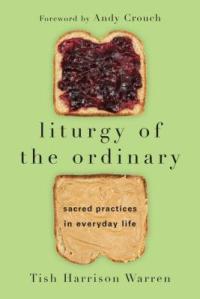
The overall Book of the Year winner comes under the category of Beautiful Orthodoxy. Liturgy of the Ordinary: Sacred Practices in Everyday Life by Tish Harrison Warren. Warren takes the common incidents of our day and reminds us of their spiritual significance. From one reviewer: “Warren takes you through a single ordinary day, from waking up in the morning to going to sleep at night, and manages to make connections to just about every important aspect of the Christian life. She is a gifted writer whose stories, rife with humor, teach you deeper things without ever making you feel like you’re being instructed.” (Stan Jantz) An article taken from the book is included in CT and this alone has made me anxious to read this book.

If you like to read about the other winners: http://www.christianitytoday.com/ct/2018/january-february/christianity-todays-2018-book-awards.html

Have you already read any of these books? Ready to add them to your TBR?


Wiley Cash: The Last Ballad

Looking to read more from local (North Carolina or anywhere in southeast) writers, I picked up the latest from Wiley Cash a few weeks ago.

The Last Ballad tells the story of Ella May Wiggins, a woman who worked in the textile mills of North Carolina in the 1920’s. In 1929, she leaves Bessemer City to go to Gastonia to hear about the union and their plans to strike. Ella May works hard every night, having to leave her four children (the father of her children has abandoned them). Joining a union is dangerous and will probably lose her her job, but what choice does she have? Her children are hungry and she can’t afford to clothe them. Something has to change.

Wiley Cash is a writer that any writer would envy. He writes of hard times, desperate situations, evil and selfish people with poetry and grace. He takes a woman who lived in an impossible situation and shows her courage and determination. I highly recommend this book, and will be checking out the backlist for Wiley Cash.

For those of you who read ebooks, this book is available for $1.99 across the different vendors for a limited time.

How about you? Do you enjoy reading from your local authors? Who are your favorites?

Seventeen of my Favorite Books from 2017

Looking back over 2017, I can’t say I’ve accomplished all my goals, but I did meet and go beyond my goals for reading. Okay, I manage to accomplish that goal every year–through college, having babies, homeschooling, working on my masters, etc. No matter what my year may bring, I will always squeeze in some reading time.

So, what were my top reads of 2017? Trying to cull my favorites was challenging, but thanks to Goodreads (my memory is not so great), I have come up with my top 17 from various genres. Some of these have been mentioned in previous posts and one I plan to review later, but I didn’t want to leave them out.

Historical fictionThe House of Riverton Kate Morton; The Alice Network by Kate Quinn; The Women in the Castle Jessica Shattuck; Small Island by Andrea Levy; Wiley Cash The Last Ballad

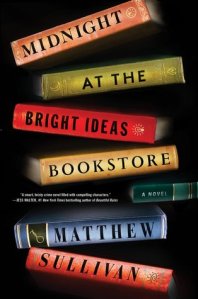
Suspense/mysteryThe Dry by Jane Harper; The Devotion of Suspect X by Keigo Higashino; India Black by Carol K. Carr; Midnight at the Bright Lights Bookstore by Matthew Sullivan. All of these books were suspenseful, entertaining, and not what I was expecting. (I know; maybe if I read the blurbs? But sometimes they are so full of spoilers.) I picked up Midnight at the Bright Ideas Bookstore because a book group I’m in was going to read it and because, well, a great cover. If I knew it would start with a suicide in a bookstore, and something terrible happened to the main character as a child, I probably wouldn’t have started it. But, once I did, (except for the night I knew the bad thing was about to happen, so I closed it until morning), I could hardly put it down. Great story. 

Historical Romance: The Painter’s Daughter Julie Klassen

Christian Living: Crossing the Waters by Leslie Leyland Fields

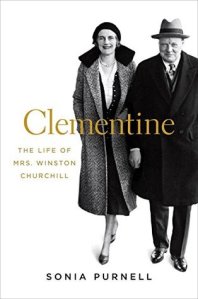
History/Biographical: Clementine: The Life of Mrs. Winston Churchill by Sonia Purnell; Destiny of the Republic: A Tale of Madness, Medicine, and the Murder of a President by Candice Millard (assassination of James Garfield); Ice Ghosts: The Epic Hunt for the Lost Franklin Expedition by Paul Watson. 

Literary Fiction: Bel Canto by Ann Patchett. I’ve heard for several years about what a great book this one is, but a book about some terrorists taking over a party of VIP guests in a South American country? Just didn’t sound appealing, but Ann Patchett is such a great writer, I finally had to try it. It took me a few chapters to get into it, but once I did, I was engrossed.

Young Adult: The Sun is Also a Star by Nicola Yoon. I listened to this one, and the narration is superb. 

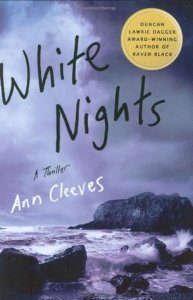
Best Series: Shetland Island by Ann Cleeves (Read the first six; also belongs under Mysteries)

What about you? What were your favorites this year? What books are you looking forward to in 2018?

Dorothy L. Sayers: Apologist and Mystery Writer

“I always have a quotation for everything; it saves original thinking.” Dorothy Sayers.
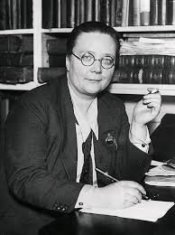
Dorothy Sayers (1893-1957) wore many hats, but it is the labeling her as “apologist and mystery writer” by one article which makes me smile, and I believe would amuse her as well.

Born at Oxford, the only child of the Rev. Henry Sayers, she won a scholarship to Somerville College (a college of Oxford, started specifically for women). She graduated in 1915 with first class honors in modern languages.

She wrote her first “Lord Peter Wimsey” mystery, Whose Body?, while working at a London advertising firm. She went on to write several novels and short stories featuring Lord Peter Wimsey. The books are still being published today and many of her readers are unaware of her many other accomplishments.

Sayers considered her best work her translation of Dante’s Divine Comedy. Sayers was 51 when she first read the Divine Comedy, and she became consumed with it. “I bolted my meals, neglected my sleep, work, and correspondence, drove my friends crazy . . .” Deciding to make a fresh translation of his work, she learned the Italian necessary, and the translation remains in print.

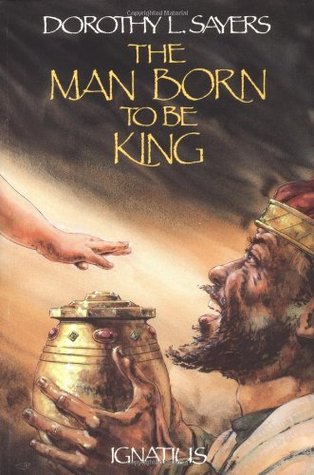
Of all her writings, it is concerning a particular play–The Man Born to be King–I want to write about today. She wrote her first play, The Zeal of Thy House, for the Canterbury Festival. She then wrote six more plays including The Man Born to be King. I read this play over ten years ago, and have decided to reread it this year as part of my “Christmas reading.”

This play was originally written for the BBC for broadcasting in the children’s hour. Sayers’ depiction of Christ has him speaking in modern English (since her audience would hardly know Greek) which caused a great outcry of protests. Didn’t she know Jesus (and all those around him) spoke in King James English? One newspaper editor put it this way: “In quoting the Bible we must take the Authorized Version, and not the interpretation of scholars, however wise.” Sayers response: “Of this singular piece of idolatry I will only say that it imposes difficulties upon the English playwright from which the Greek tragic poets are free.” She further explains that as the Incarnation really happened–meaning God became a man and lived among common, ordinary people–he, consequently, spoke a common, ordinary language.
This speaks to me as a writer as I have been wrestling with criticism concerning some of my dialogue. Some say my dialogue sounds too modern, and I wonder if they’re expecting King James English (the Authorized Version) as well? I understand the characters shouldn’t sound like 21st century Americans, but I do not know the Hebrew language and do not believe my characters spoke in any superior sort of way. The whole point of writing about Biblical characters is to remind us that they were real people and not merely “characters.” The sons of King David, though sons of a king, were also shepherds and warriors. Yes, David was a poet and a song writer, but does anyone really think he went around speaking poetically to his sons? Or that Solomon spoke in proverbs in his every day life?

When Sayers wrote her play, she wanted her audience to remember also that these characters did not know what they were doing. “We are so much accustomed to viewing the whole story from a post-Resurrection, . . .point of view, that we are apt, without realising it, to attribute to all the New Testament characters the same kind of detailed theological awareness which we have ourselves. We judge their behavior as though all of them–disciples, Pharisees, Romans, and men-in-the-street–had known with Whom they were dealing . . . But they did not know it.”

Sayers goes on to explain that when we show how real the people were who “made vulgar jokes about Him, called Him filthy names, taunted Him, . . .”, we are shocked, and we should be. However, when we pretty up the language and think of it all as in a culture and people far removed from us, we are not quite as shocked and do not see ourselves as those very people (as we should). “It is curious that people who are filled with horrified indignation whenever a cat kills a sparrow can hear that story of the killing of God told Sunday after Sunday and not experience any shock at all.”

In the same way, I wish for people who read my stories to see themselves in these Bible characters. To understand that we are just as sinful, just as fallen, and just as in need of a Savior. If a reader does not relate to the characters as people like themselves, they will only view the stories as just that–stories.

I’m looking forward to rereading these plays with a new eye than when I read them before. If you want to join along, please comment and let me know!

“The only Christian work is good work, well done.” Dorothy L. Sayers


Charles Dickens and Serial Fiction

Starting tomorrow, I will begin posting a new story in eight parts. I will not wait a week between each posting as I did with my last story, and each installment (except the last) will be considerably shorter than the installments of “My Name is Absalom.” I believe these shorter installments will be more attractive to those who like to read on their phone–whether waiting in line or finding yourself with a few minutes to kill waiting on a doctor or a loved one, etc. (not waiting in traffic, please).

Serial fiction is nothing new, and in the 19th century, many books were first published this way. I knew Charles Dickens published some of his books in serial fashion, so I decided to do a little research to learn more about how and why he published in this way.

First I learned that Dickens published all of his books this way. I heard someone just a few days comment (complain?) about the wordiness of Dickens’ books, but serial publishing explains this to some degree. No one in the 19th century sat down with an over 800 page copy of David Copperfield or Bleak House. Most of his novels were published in twenty parts. In Dickens’ first book, The Pickwick Papers (1836-1837), thirty-two pages of text along with two engraved illustrations, and sixteen pages of advertising sold for a shilling. The last installment cost two shillings as the text and illustrations were doubled and other parts were included such as a preface, table of contents, list of illustrations, etc.

Other authors who published in serial form include: George Eliot, Thomas Hardy, Anthony Trollope, and William Makepeace. In the early 20th century, books by Hemingway, Edith Wharton, and F. Scott Fitzgerald were also serialized. Their books were serialized in newspapers often after they had already come out in books.

In this century, several books have come about after being posted as blog posts. Andy Weir first posted the chapters of his book, The Martian, as blog posts after failing to publish other books. When his fans wanted it put in book form, he created a Kindle version for .99. After selling 35,000 copies in three months, he finally had the attention of some publishers, and the rest, as they say, is history.

How about you? Do you enjoy reading short stories in serialized form? Or even books? What type of stories do you think are best suited for being published in several installments?


Six Audio books of Different Genres For Your Listening Pleasure

As I’ve mentioned in a previous post (https://pmgilmer.com/2017/02/), listening to audio books is both a new and an old kind of reading for me. I started listening to some while walking, then tried while driving. When I first tried to listen while driving, I would find my mind wandering and lose track of the story. I now find myself frustrated if I don’t have a good book to listen to while driving. A few weeks ago, I started three different ones without even finishing the first disc. Having to drive with nothing but the radio (which I had done for years, after all) drove me crazy until I finally settled on a book I could enjoy.

Since I know there are a few others of you out there who enjoy audio books, I thought I would share some that have held my interest enough to make me want to take a long road trip to finish them. These books are of different genres as I get bored reading books of the same genre.

First, a children’s book, The War that Saved My Life by Kimberly Brubaker Bradley. Though I listen to Young Adult books on occasion, listening to this one made me realize I may have been overlooking some fun and entertaining books by not listening to more children’s books. Nine-year old Ada is never allowed to leave her one-room apartment because her mother is embarrassed by her clubfoot. When her brother and other children of the neighborhood are gathered to send them out of London to protect them from the coming war, Ada escapes to join them. They are taken in, rather reluctantly, by Susan Smith who treats Ada like a normal child for the first time in her life. As Ada learns to read and ride a pony, she also learns about love and trust. But, the war can’t last forever. Will she have to go back to her mother? And shouldn’t she want to?

For suspense: Behind Closed Doors, by B. A. Paris. When Grace meets Jack–a handsome, successful lawyer–she believes she’s found the perfect man. She can hardly believe he wants to marry her and willingly accepts her sister with Down’s Syndrome as part of their family. To the outside world, Jack and Grace seem to be the perfect couple. Except–why doesn’t Grace ever answer the phone? Or go out on her own? And why are bars on their bedroom windows? Honestly, not the type of book I usually read because it totally creeps me out. Which is also the reason I couldn’t quit listening.

Historical fiction: The Tea Girl of Hummingbird Lane by Lisa See. I’ve listened to several books by Lisa See and this is my favorite so far. See tells of a Chinese ethnic minority, the Akha, who raise tea in a very secluded environment. Their culture and traditions make a fascinating read, but it is the characters who make the story. Li-Yan receives an education that few are granted in her world and becomes an interpreter for her people. When she becomes pregnant out of wedlock, she manages to hide her baby (rather than kill her as her culture would dictate) and bring her to a city where she leaves her with a teacake. The baby is adopted by a wealthy California couple. Haley leads a happy life, but wonders about her origins. Meanwhile, Li-Yan goes on to learn more about the modern world and becomes a bridge between this new world and her old one. Through the world of tea, they both search and long for each other.

More historical fiction: The Alice Network by Kate Quinn. A difficult, but fascinating read about a woman, Eve, who was a spy against the Germans in WWI and now spends her days drunk, full of rage, fear and regret. In 1947, Charlie St. Clair, shows up at her door looking for her cousin. Though she finds Eve pathetic, she believes Eve can help her and eventually obtains her help. Along the way, she learns Eve’s story–about her grossly misshapen hands and the demons she tries to hide. This story is based on a true female spy network used in WWI.

Historical Mystery: A Study in Death by Anna Lee Huber. This is the fourth in the Lady Darby series, taking place in Scotland in 1831. I have listened to all four of these and look forward to the fifth book. (I reviewed the second book last year: https://wp.me/p1X6gd-fP) In this installment, Lady Darby has been commissioned to paint a portrait of Lady Drummond. When Lady Drummond is found dead, Lady Darby is appalled at Lord Drummond’s seeming lack of concern and suspects poison. She suspects Lord Drummond, too, but how can she prove it? He is a respected gentleman, and Lady Darby is still trying to overcome her past left her by her late husband.

Finally, the book I’m listening to now: Rise and Shine, Benedict Stone Phaedra Patrick. Benedict Stone, living in a quiet English village, finds himself stuck and his life falling apart. His marriage is in trouble and business at his jewelry store is almost non-existent. Then one night, a teen-age girl shows up on his doorstep. Gemma, the daughter of his long estranged brother who left for America years ago, has lost her passport and seems to be rather lost herself. Together, they learn about family and how to help and encourage one another.

How about you? If you listen to audio books, how do you find the ones you like? How important is the narrator to you?


In Search of a Critique Group

Critique groups for writers are a necessary evil. Aren’t they? Most of us who write prefer our own company to any other. Also, as long as we are the only one reading our writing, we can believe it’s pretty good. Or not too bad. Or actually, it’s terrible and not worth the hard drive on which it has been stored. (See what I mean?)

But there comes a time when, if we’re serious about putting our work out there to the public in some way (preferably publication as in people are lining up to buy our books or we’re winning prizes for our stories and New York is calling), we must find some other writers who can give us constructive feedback. Letting your friends and loved ones read your work and tell you it’s the best book they’ve ever read (even if they haven’t read anything since high school) is all well and good, but will not impress any agent, editor, or publisher.

How to find that perfect critique group has eluded me so far, so, unfortunately, I am not here to give you any helpful tips if you are in that same position of looking for a good group. I have a couple of possibilities right now, and I hope to be able to share with you in the next few months about how I have finally found that group and how amazingly helpful they have been.

So, while I’m continuing my quest for a critique group, I will share the basic guidelines for what I expect from a group, and maybe you can suggest a few more. The first may seem obvious, but you would be surprised. Everyone in the group needs to be writing and to be serious about writing. (Who would join a group about writing who isn’t actually writing? All those who dream about writing and know how easy it really is, and think ‘what’s the big deal anyway?’)

Secondly, everyone needs to be willing to share something of what they’ve written and be willing to listen to everyone’s comments on their selection without being defensive or apologetic. And, third, everyone needs to be willing to read the writings of all members and give helpful feedback. No “this was great” or “this was terrible.” Be specific at what you like, don’t like, or feel needs to be made more clear.

Coming Soon: Besides rewriting Solomon I (totally changing the POV; more on that another time) and working on Solomon II, I’m working on a story to post in this very blog. Soon.

Fun Fact: I noticed when I started writing this blog, I have published one hundred posts, so here’s to 101.

P. S. For any of you writers out there, the Charlotte Writers Club has their nonfiction contest open now. Any piece of unpublished nonfiction from 750-2000 words may be entered. For more information, check out their website: charlottewritersclub.org

How about you? Have you been part of a critique group? What worked and what didn’t?


Trip to the Outer Banks-Part 2

To continue with our trip: Of course, we made plans to visit the most famous lighthouse of all–Cape Hatteras, also known as America’s Lighthouse. Confession: I thought it was the only lighthouse on the Outer Banks. I obviously need to get out more. Since we stayed in Kill Devil Hills, our trip to Hatteras took us close to two hours. Recent hurricane weather had flooded the roads and what was to be a “scenic drive” was mostly driving through water and seeing rather large sand dunes on the sides of the road. Still, I enjoyed the drive and what scenery we could see.

Having climbed one lighthouse and spending $10 for the privilege, I was content to view this lighthouse from the ground. My husband, however, was up for the challenge (and saw a deal in $4 for seniors) and made the climb. I promised to wave to him when he got to the top, but spent a little too much time in the museum and gift shop, or bookstore. Someone waved to him, however, (who apparently looked amazingly like me–from the top of a lighthouse anyway), so thanks whoever you are!

We also visited The Graveyard of the Atlantic Museum. (I don’t know why I didn’t take a picture outside. None were allowed inside.) The most interesting sight here is the “lost lens” from the original Cape Hatteras Lighthouse. There are also artifacts from the ghost ship Carroll A. Deering. This ship passed Cape Lookout Lightship on January 29, 1921. Some months later, the ship was found abandoned and no one knows what happened to the crew. For more reading on this mystery: https://www.nps.gov/caha/learn/historyculture/theghostship.htm

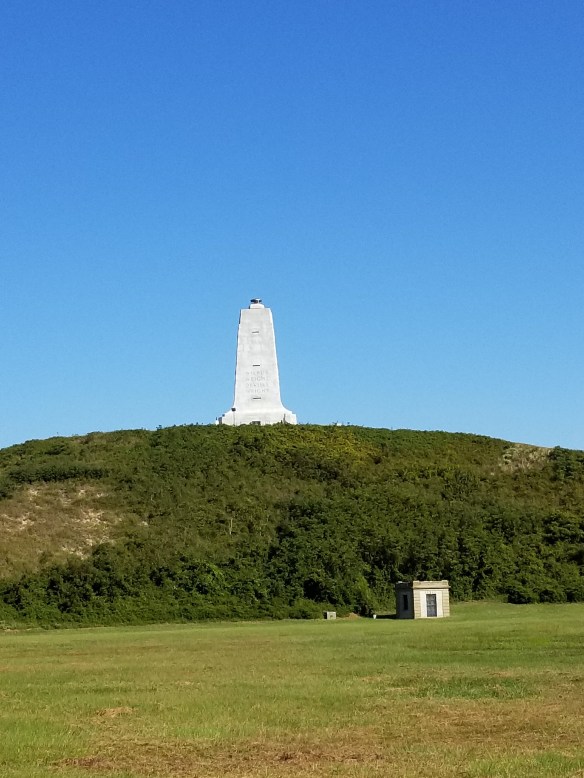
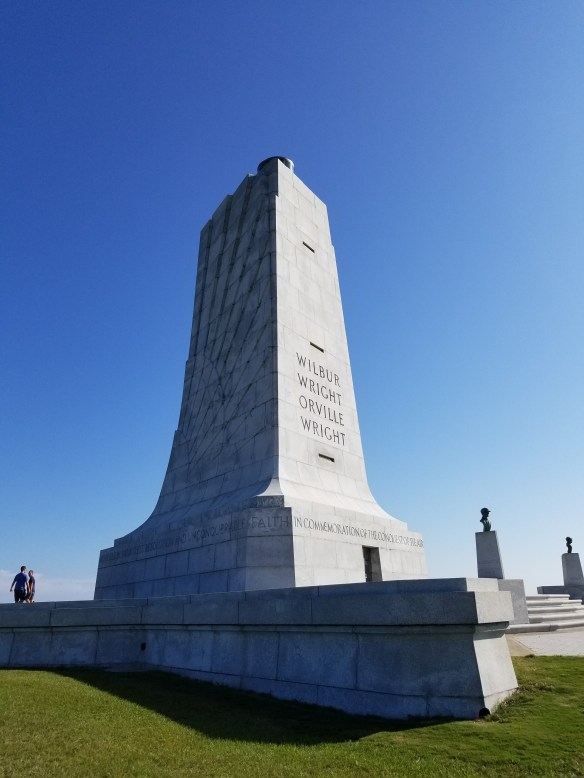
On our last day, we started by visiting the Wright Brothers National Memorial. Though the museum is still under construction and won’t be open until next year, we were still able to climb the hill that had been the sand dune where the brothers performed many of their experiments and now displays a monument in their memory. This climb was almost as difficult as the one up the lighthouse and will give you a new appreciation for the determination the Wright Brothers had and the work they put in to learn to fly. Reading David McCullough’s book The Wright Brothers last year helped me to understand better what the Wrights accomplished. I’m afraid the vision I retained from my elementary days was of a couple of old brothers jumping off a sand dune with a strange-looking contraption. Obviously, there was quite a bit more to it than that, and I can highly recommend McCullough’s book for more detail.

As no vacation would be complete without a visit to at least one bookstore, we visited a couple, including ones at every historic site we toured as well as the Island Bookstore in Kitty Hawk.

And, finally, though we ate some good food at several places, I had to make a stop at Duck Donuts before we left.

There’s still much we didn’t see on our trip to the Outer Banks, so hopefully, we can go again someday. Maybe I’ll even climb another lighthouse. How about you? Visited any lighthouses lately?

Trip to The Outer Banks, N.C.–Part 1

Last week, my husband and I made a trip to the Outer Banks, N.C. to celebrate our 30th anniversary. We’ve lived in N.C. twenty-nine years, but this was our first trip to the Outer Banks. There are closer beaches, but I wanted to see the lighthouses and learn more about the history of both the Outer Banks and our state. The Outer Banks is home to five lighthouses, and we managed to see three of them.


On our first day, we went to Corolla and visited the Currituck Beach Lighthouse. This lighthouse began flashing its light in 1875 and stands at 158 feet. I enjoyed climbing this lighthouse and seeing the great view from above.

Near the lighthouse is the Corolla Schoolhouse. When exactly this one-room schoolhouse was opened is unknown, though some sources cite it as early as 1890. It was closed in 1958. In front of the schoolhouse is a Little Free Library, a replica of the schoolhouse.

After a lunch in Duck (where there are plenty of food options), we ended the day with a walk and some reading on the beach at Kill Devil Hills.