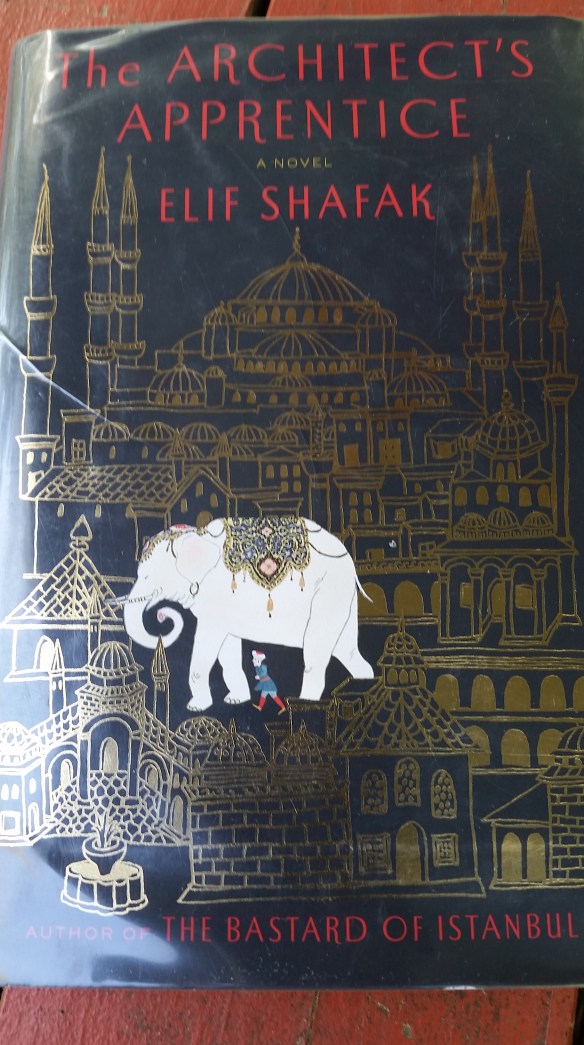
The Architect’s Apprentice by Elif Shafak

20160414_095717

The Architect’s Apprentice is a very engaging and entertaining story which takes place in Istanbul in the 1500’s. The story is told through the eyes of an apprentice to the architect, Mimar Sinan, who designed buildings (mostly mosques, but also bridges) during the Ottoman Empire. Sinan, a contemporary of Michelangelo, was appointed to be the chief royal architect at the age of 50 and kept the post for almost 50 years.

His apprentice (in this story) was an Indian boy, Jahan, who arrived in Istanbul with a white elephant which had been sent as a gift for the Sultan. The city, its politics and intrigues, are seen through Jahan’s eyes as he continues to be the mahout, or keeper of the elephant. He soon catches the eye of Sinan with his own drawings and is made Sinan’s apprentice though he continues his duties as mahout. The white elephant, Chota, is as much an important character as Jahan and Sinan. Chota and Jahan grow up together, serving the Sultan, both in war and in helping with building bridges and mosques, designed by Sinan.

This is a time and place in history which I have not been very familiar with, so that added to my interest for the story. Any other books written about this time period that anyone can recommend? Or other books about the architect, Sinan?

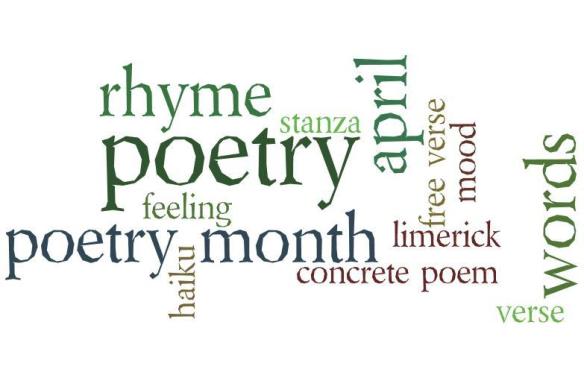
April is National Poetry Month

spring poetry wordle

April is National Poetry Month, so it’s a good time to, not only read some poetry, but to discover some new poets and explore different types of poetry. I have to admit, that my reading has not included reading poetry as much as it should, though when I think about it, I have enjoyed poetry through the years. My earliest memories include the love of Green Eggs and Ham and Fox in Socks. What better introduction to poetry than Dr. Seuss?  Though it was required reading for me in college (usually a death knell to the enjoyment of reading), I greatly enjoyed reading Paradise Lost as well as The Odyssey.  As a writer, reading poetry helps me to see words in a different way; a more musical way. Ray Bradbury read poems before beginning a day’s work. In Zen in the Art of Writing, he said, “Poetry is good because it flexes muscles you don’t use often enough. Poetry expands the senses and keeps them in prime condition.”

I am now reading through a collection of poems edited by my favorite poet, Luci Shaw. The collection,  A Widening Light: Poems of the Incarnation, includes poems from several poets, including Luci Shaw herself. Using poetry to help us worship God is nothing new. We all know the Psalms as works of poetry, as well as the books of Job, Proverbs, Ecclesiastes, and Lamentations.

poetry

Perhaps no one explains better why we should read poetry than the teacher, John Keating, played by Robin Williams in Dead Poets Society.

In anticipation of hearing Shelby Stephenson, Poet Laureate of North Carolina, speak next week, I am going to pick up his book, Fiddledeedee, from the library.

Any favorite poets or poems you’ll be reading this month?


On ReReading

20150725_102305

I’ve been doing some rereading this summer, something I haven’t done much of since I was a teen and read The Outsiders a countless number of times. I’ve seen the subject discussed on goodreads, and recently read another blog on the subject, so I thought I would share my own recent experiences in rereading, including the rereading I have been doing this summer. I would love to hear from others on what they reread and why. I know most of you readers are like me and feel that with “so many books to read, so little time”, how can anyone possibly justify rereading? Well, there are several reasons, but read on for mine.

First, let me mention a legitimate fear in rereading and that is the possibility of returning to a book you enjoyed at an earlier time, but when you reread it, you’re disappointed and wonder ‘what in the world did I see in that book?’ Obviously, we are different people at different times and usually a book will mean different things to us at different times. However,the well-written book will stand the test of time, even if it means something different to us upon rereading.

A series of books I recently reread was the Harry Potter books. I know; almost a cliche. I don’t know how many times my five kids have reread those books. I read them the first time as they came out; before they were a cult, a fad, a part of our culture. I bought the first one for my oldest son (now 23) and began reading it to him; though a few chapters in, he took it upon himself to read it alone. A couple of years ago, I decided I wanted to see the movies because I had only seen a couple of them, (having stayed home with “the babies” when the first ones came out, and my husband took the oldest ones to see them). Now, with the “baby” being 13, I told him I wanted to watch the movies with him, but only after I read the books. So, we would reread a book, then watch the movie together. So, I reread this series for two reasons. One: I wanted to see the movies, but not without returning to the books first (and in most cases, I don’t know how you know what’s going on without reading the book first). Two: to spend time with my son doing something we both enjoyed.

This summer I find myself rereading several books in different genres for different reasons, though they all boil down to the simple reason of: I want to. I am currently rereading Lord of the Rings. I have read this several times, but probably not all three in over 20 years. It was just time. I’m rereading Gap Creek by Robert Morgan. I read this several years ago and enjoyed it for his beautiful writing and because I know the characters lived a lifestyle shared by my own grandparents and great-grandparents, and I find this fascinating. I have wanted to reread it for awhile, but having bought Morgan’s sequel The Road fro Gap Creek, I decided this was the time.

Two other books I am rereading this summer are about as different from each other as possible. The first is Bill Bryson’s A Walk Through the Woods. One of the few books that my husband and I have both read. We agreed it would be good to reread this before the movie comes out. Two chapters in, I am already laughing and glad I found a used copy on AbeBooks.

The other book is Mere Christianity by C.S. Lewis. I first read this in college and have probably read it a couple of times since. My apologetic skills are weak, so I knew this deserved a reread before I tackled some new books in that area.

For another view on rereading, check out Kelly Jensen’s blog: http://www.stackedbooks.org/2015/07/on-becoming-re-reader.html

What about you? Are you doing any rereading this summer?

Secrets of a Charmed Life by Susan Meissner


2015-05-22 19.14.46

I picked up Secrets of a Charmed Life because I have read other books by this author and have always enjoyed them. When I realized it was “another WWII novel”, I almost put it away for another time. Historical fiction is probably my favorite genre, and I have read and enjoyed my share of WWII novels, but lately, there just seems to be a glut of books taking place in this time period in both my reading and my TBR pile of books. However, I’m very glad I decided to go ahead and read this novel. It may be “another WWII novel”, but it has its own charms (sorry!).

The story is told as an older woman looking back and telling her story, for the first time ever, to a student reporter. So, it begins in present day Oxford, but mostly takes place as a flashback to the war and the effect it had on two children who were among the ones evacuated from London to protect them from the coming Blitz.

This is a story of two sisters who are caught up in a war, their separation, and the trials they go through to find each other again. It’s a story of motherhood, sisterhood, forgiveness, and learning to live with and through our mistakes.

It’s a story of history; both personal and worldwide. As one character says of history: “What good is remembering an event if you don’t remember how it made you feel. How it impacted others. How it made them feel. You would learn nothing and neither would anyone else.”

I highly recommend this book by Meissner as well any other book she has written. Check out her other books on her website: susanmeissner.com


Book Riot Read Harder Challenge

kingdom of ice 2It’s a new year and goals and challenges are being discussed. Resolutions are still made, but usually with a sheepish grin. We want to change, but, being honest, we know how long, or how short, most of these will last. So, you can lose your weight, eat healthier, and exercise more, but being a reader, I am more interested in what other readers are doing and how I can challenge myself to read or to “read harder” as Book Riot has put it. I’m not really looking to read more, and will continue to read for pure pleasure and enjoyment, but adding a challenge to my reading will broaden my reading horizons. I have already decided I will read more non-fiction this year, and have started by beginning to read Hampton Sides In the Kingdom of Ice. 

Book Riot has issued their “Read Harder” Challenge which you can read here: http://ow.ly/FZLwd To read harder, you must choose a book that will fit within the 24 different categories they have presented. These categories include reading a book written by an author under the age of 25, reading a science fiction book, a romance book, a book written by an author from Africa, and a microhistory.

Am I going to try and do all 24? No. For a couple of reasons. One, I have books I want to read just because I want to read them, and others I will be reading for various book groups, and I’m not going to put them aside just to participate in this. Two, I want a challenge, but not something that will take the fun and enjoyment out of reading.

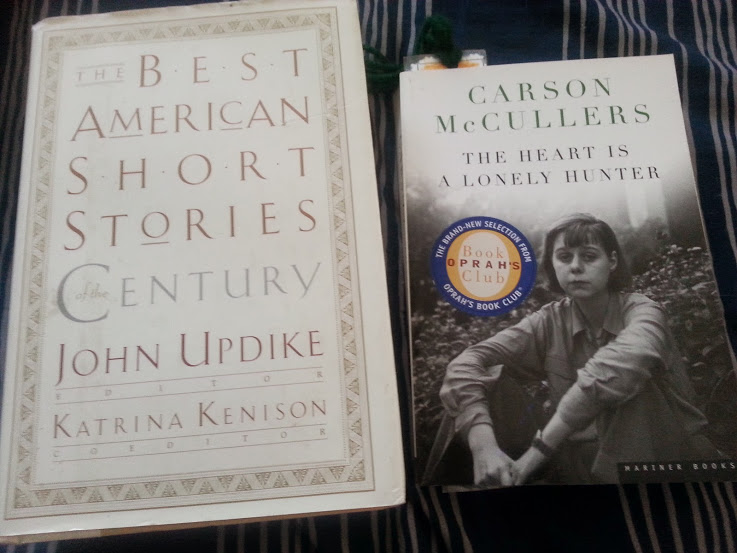
But, I am going to pick a few selections and make an effort to read those and join in with the group on goodreads. The first challenge is to read a book written by an author under the age of 25. I have a copy of Carson McCullers’ The Heart is a Lonely Hunter which has been languishing on my bookshelves for years. In fact, I had to do a bit of digging to find it. McCullers was 23 when she wrote this book, so I am choosing it to take on the first task.

Another task (number 3) is to read a selection of short stories. Another book I’ve had for awhile is The Best American Short Stories of the Century, edited by John Updike. Though I’ve read a story from it here and there over the years, I’ve never read it all the way through. Though I may take most of the year to get through it, I will begin to read it, keeping track of the stories as I read them (since I probably won’t read them in order).

SS & Carson McCullers

Some of the tasks I will be able to check off fairly easily as I go about my regular reading. This may seem like cheating, but, hey, it counts! For example, I have a hold on Overdrive for Nicholas Sparks’ The Longest Ride on audio. Once I get that and listen to it, I will have completed task 16 (audiobook), task 6 (written by a gender different than myself; i.e. a man), and task 13 (romance).

What about you? Have you given yourself any reading challenges? Taking on any of the tasks from Book Riot? Or do you have a recommendation for a book from Indie Press? (That would help me with both tasks 4 & 18).


Feasting on Poetry: Lessons Learned on Reading, from C.S. Lewis’s The Last Battle

matthewamoser's avatarChrist & University

71299-_1Today, readers, we are very pleased to bring you a special guest post by Megan Von Bergen. Professor Von Bergen brings up some very interesting issues about teaching students how to read poetically. Take and read!

*

I teach writing and literature at a small Bible college in the Midwest. Because my students all profess a faith in Christ, I usually select course readings based on what I feel will encourage and challenge them in that faith.

Every spring, I ask my students in Introduction to Literature to read C.S. Lewis’s The Great Divorce. Every spring, my students ask me whether they should take Lewis’s depiction of Heaven and Hell at face value. I want them to know what Lewis says about how we approach God in this life. All they want to know are the specifics of his eschatology.

View original post 1,234 more words

Surprised by Oxford–A review

surprised by oxfordI enjoy reading of the spiritual journeys of others for several reasons. Being raised in church with the Bible always accessible to me and my questions, I find it particularly intriguing to read of those who have come to God in less “conventional” ways. How God seeks and saves those are who lost is a source of encouragment and inspiration to me in my own daily walk.

Surprised by Oxford is the story of one young woman’s spiritual journey her first year at Oxford. For those familiar with C.S. Lewis, yes, the title is intentional. Just as Lewis was an agnostic, not looking for God, and not interested in learning of a “personal” God, so Weber went to Oxford to study literature; not to find God. But, God surprised her there at Oxford by putting in her path Christians who lived what they believed and were to able challenge her own beliefs with love and intelligence.

Oxford image

Some of my favorite quotes:

“that no matter how misleading the title of the theory of relativity, absolute rules the physical as well as the metaphysical. For me God’s love is so great that it can attract even the farthest, most lost, most seemingly random call to Him” (p. 127).

“It was occurring to me that believing in the Bible was an all-or-nothing affair. Either you believe it is the revealed Word of God, or you don’t. It is like being a little bit pregnant. Impossible. Either you are in or you are out” (p. 138).

“That is the bizarre thing about the good news: who knows how you will really hear it one day, but once you have heard it, I mean really heard it, you can never unhear it. Once you have read it, or spoken it, or thought it, even if it irritates you, even if you hate hearing it or cannot find it feasible, or try to dismiss it, you cannot unread it, or unspeak it, or unthink it” (p. 81).

To learn more about Weber, how she has spent the past 15 years and about her new book, check out her blog on: www.pressingsave.com

Oxford 018

Surprised by Oxford

2013-10-02 16.21.26“So faced with a thousand-year old institution, I learned to pick my battles. Rather than resist, for instance, the archaic book-ordering system in the Bodleian Library with technological mortification, I discovered the treasure in embracing its seeming quirkiness. Often, when the wrong book came up from the annals after my order, I found it to be right in some way after Oxford often works such.

After one particulary serendipitous day of research, I asked Robert, the usual morning porter on duty at the Bodleian Library, about the lack of any kind of sophisticated security system, especially in one of the world’s most famous libraries. The Bodleian was not a loaning library, though you were allowed to work freely amid priceless artifacts. Individual college libraries entrusted you to simply sign a book out and then return it when you were done.

‘It’s funny; Americans ask me about that all the time,’ Roberty said as he stirred his tea. ‘But then again, they’re not used to having in honour,’ he said with a shrug.”

Surprised by Oxford by Carolyn Weber

Oxford 016

Internship at SPCC

I just finished my library internship at South Piedmont Community College. P1000430

Finally being able to do some hands-on work at a library was very rewarding. I did weeding, updated libguides, added links to research guides, and updated computers.

WEEDING

P1000406

END OF A REFERENCE ERA

P1000411

I was also able to attend a conference by the Metrolina Library Association at Johnson & Wales in Charlotte.

Metrolina Library Association


My main project was an in-service project required for my class. SPCC is looking into subscribing to a new database for academic e-books. I did research on both EBSCO’s and ProQuest’s Ebrary’s academic collections, made comparisons, and did a PowerPoint presentation for the librarians from both campuses. Shortly after I did my presentation, I discovered that the Bodlein Libraries of the University of Oxford was also giving these two databases a trial. http://www.bodleian.ox.ac.uk/notices/2013-mar-22    I’ll be interested in learning more about their discoveries and conclusions.

ebscohost

ProQuest


I was also able to spend some of my hours at the Monroe Public Library of Union County, working on collection development. Thanks to both of these libraries for giving me the time & experience, and help me to get one step closer to that diploma!

upublib