Beneath a Golden Veil by Melanie Dobson

20161207_114254In Sacramento in 1853, the gold rush is on and people are coming from all over the country to try their luck. Isabelle runs a hotel and seems to be successfully overcoming a secret in her past, in spite of the loss of her beloved aunt. When a man enters her hotel in search of his slave, Isabelle becomes involved in helping and hiding slaves in this state which has no clear laws on the issues of slavery.

From Virginia, comes Alden with a twelve year old slave, Isaac. Isabelle recognizes Alden from her past, but he does not recognize her. Soon, another man from Isabelle’s past arrives in Sacramento, and Isabelle has no doubt that this man means her harm. Isabelle becomes caught between wanting to help others who are trapped in slavery and needing to save herself. Her aunt taught her to trust in God, but can she trust Him to deliver her from this evil?

This is my first book by Melanie Dobson though I have read good things about her books and have had a couple of them on my TBR for awhile. Receiving this Kindle edition gave me my excuse to read Dobson’s newest book, and I was not disappointed. I don’t remember ever reading before of California’s stance during the time of slavery or hearing of their own underground railroad, so I found the history interesting and appreciated the details Dobson brings to her story. There is romance, suspense, and colorful characters–all helping to bring together an entertaining story. I gave this book five stars on Goodreads.

Though I received a free Kindle copy through Goodreads, the review is my own.

Dying in the Wool by Frances Brody/book review


20161106_075045As you all know, I enjoy historical mysteries, and thanks to goodreads and the historical mystery group I’m in, I have found another series to relish. Dying in the Wool is the first of eight mysteries set in England after WWI which introduce Kate Shackleton.

Kate’s husband went missing four years before during WWI, and though most presume him to be dead, Kate has not given up hope for his safe return. In the meantime, Kate is trying to establish herself as a photographer, and she has also solved several mysteries involving missing persons. When a good friend, who is soon to be married, asks her to look for her father who went missing several years before, (wanting him to be there at her wedding), Kate agrees and is soon involved in learning the secrets of a mill town in an otherwise quiet Yorkshire village.

I usually try to avoid comparisons with other books as they are often misleading and disappointing. I don’t like to be told a book or an author is like another and after reading it, discover it’s not in any shape, form, or fashion like the one it has been compared to. In fact, it can take away whatever enjoyment I might have had if my expectations had been different. However, I do believe readers of both Jacqueline Winspear and Charles Todd will find this series entertaining in a similar vein. Having only read the first book, I can’t say how well the series continues, but I hope to find out soon.

How about you? Reading any new mysteries? Or have any of you read anything else by Frances Brody?


The End! Or, at least, the Beginning of the End

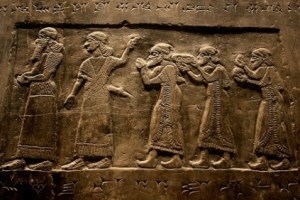
3blackobelisk-of-shalmaneseriii-tewkes


I just came to the end of my book. Not one I am reading–the one I am writing. And like so much of this book, it was kind of unexpected.

Ok, I have some rough spots and a couple of places I know I want to rewrite, but I actually came to the end. I was planning on another chapter. Actually, have it started and sort of have an outline for that final chapter. (In my mind, that is, which is where most of my outlines actually live).  So, I was working on finishing up this chapter, started adding a bit, then realized as I completed the chapter that I really could end the book here. I’ve long since conceded that it is going to take another book to tell the story I want to tell. Since I have (gasp) 113, 308 words, perhaps it is time to wrap this up. But, I have so much more to say! You think because you’re the author that you’re in control, but, no, not really.

I want to tell the story of Solomon–growing up in the court of King David. What was it like to know you were the chosen prince? When exactly did he know that? What did his brothers (and others) think of that?

So, I started telling the story. And, along the way: Solomon’s brothers are fighting; Solomon wants his father to raise horses to drive chariots; Solomon’s mother seems to be the only one who really thinks he is special; and Solomon and two of his brothers take a trip to Egypt.

So, over 100,00 words and Solomon isn’t even king yet. But, he will be soon. I can’t wait to begin writing that story, but first–I need to work on my platform. Do any of you follow your favorite writers on facebook? Twitter? Why? What do you look for? Or what do you enjoy about what they do? I hope you will all stay with me as I begin to share more of what I’ve written and begin my search for an agent.


bibleplaces-sheep

Mortal Arts by Anna Lee Huber

mortal_arts_book_cover_mediumI greatly enjoy reading historical mysteries and having now read the second of the Lady Darby mysteries, I am excited to have found a new author to follow and read.

The Lady Darby mysteries are set in 1830’s Scotland and feature a young widow, Kiera, (Lady Darby) who has artistic talent and a cloud over her past. In this book, she is traveling to Edinburgh with her sister and her family when they make a stop at Dalmay House.

Kiera’s brother-in-law, Philip, has been asked by his aunt to join her family there because her daughter is engaged to be married to Michael, the owner and friend of Philip. His aunt does not approve  of the proposed marriage and desires Philip’s support. Kiera is happy to see Michael, a childhood friend of her own. His older brother, Will, served as an art tutor for Kiera when she was only 15. Since Will has been missing for over ten years,  Kiera has believed him to be dead. They are not long at Dalmay House, however, when she learns that Will is not only very much alive, but has been considered insane and dangerous. When a young woman who lives nearby goes missing, Will is the first to be suspected, and Kiera is determined to help her friend and to learn what is behind the insanity accusations.

Though this book can be read as a stand-alone, I do recommend starting with the first in the series: The Anatomist’s Wife. the_anatomists_wife_book_cover_mediumIn this book, you will learn more about Kiera’s background and be introduced to another character, Gage, whom Kiera assists in solving a murder, and also becomes attracted to. Of course, Gage appears in Mortal Arts as well and helps Kiera solve the mysteries surrounding Dalmay House.

What about you? What are some historical mysteries you have enjoyed and would recommend?


The Improbability of Love by Hannah Rothschild

The Improbability of Love by Hannah Mary Rothschild
The Improbability of Love
by Hannah Mary Rothschild

Patricia Gilmer‘s review

Sep 29, 2016  ·  edit
really liked it

bookshelves: library-book

Read from September 23 to 29, 2016


A many layered tale about a painting that a young chef, Annie, buys on a whim from a junk shop in London. Though she is working for two art dealers, she has no real interest in art, but is soon persuaded to try and find out the origins of the painting.
Meanwhile, a powerful art dealer, who built his family business as a German Jew who survived WWII, begins to desperately seek for a painting he had given a lover who unexpectedly died. Though his daughter doesn’t understand why this painting is so important to her father, she begins to search for the painting and begins to uncover the history of the painting, as well as that of her father.
Suspense, a bit of romance, an array of interesting characters, and the history of an 18th century French artist all add up to make an entertaining tale.

An Update on My Blog & the Meaning of Its Existence

IMG_20160607_102046As it’s been awhile since I started this blog (it has died and been resurrected more than once), I’ve decided to spend some time not only updating my blog, but also explaining its purpose and what I hope to accomplish. I originally started this blog for a project in a class I was taking for my masters in library science. Since I was still homeschooling at the time, I thought of sharing thoughts and events on homeschooling that might prove interesting and helpful to other homeschoolers, as well others interested in education in any way. Reading and writing are my two main spheres of interest, so I knew my posts would be in those areas; as well as on library events and library news.

So, I’m not homeschooling any longer and that perfect library job has still not happened. Maybe it will, maybe it won’t, but in the meantime, I have become more serious about writing–my first love and what I’ve declared I would do since probably about third grade. When I was in college, it was suggested I go into teaching, but, no, I wanted to write. Well, I’ve spent quite a few years teaching–from preschool to ladies’ Bible studies–and I’ve loved it, but I still want to write.

I’ve actually written two books, so the one I’m working on is my third. The first book was read by my mother and several long-suffering friends. For some reason, I could never find an interested publisher, and, really, I didn’t know what I was doing in that area, which may have actually been a blessing in disguise. (I still don’t know a lot–but learning!) What happened to the second? I’m not even sure.

In the meantime, I want to continue to share about books I’ve read and enjoyed. Since the book I’m working on is historical fiction and that is my favorite genre, I am going to focus on books in that area but there will definitely be others–from books on writing to fantasy to Bible studies.

20160827_115205

Eventually, (and, hopefully, very soon), I will also be writing and sharing about the progress of my book. I’m excited at where it’s going and how much I have completed. I would like to share the first chapter on here at some point, but that will depend on how certain things go. I’m using a good part of that chapter to enter a couple of contests, so can’t release or share anything about it while it is out there being reviewed and scrutinized by “those in the business.”

I was going to also explain more about the title–declaretonextgeneration–but I believe I’ll save that for another blog post.

Those Dual Story-Lines

Midnight RoseI recently finished reading Lucinda Riley’s The Midnight Rose, one of those dual timelines or two intersecting timelines, or (what I prefer) a dual story-line.

https://www.goodreads.com/review/show/879379687)

This got me to thinking about how many such books I have read lately and why these dual story-lines have become so popular, and can they really be considered historical fiction in the truest sense? And how different are these from the traditional plot/subplot?

For those of you who may be wondering what in the world is a dual story-line–it is two stories told in the same book or a story within a story. The stories usually take place in the same setting but with quite a few years (approximately a hundred seems rather popular) separating the two.

The Lake House by Kate Morton was one of the first books I read this year and I just loved it. This one moved back and forth between an unsolved mystery in Cornwall in the early 1900’s and then to a woman who was visiting her grandfather (in Cornwall) in 2003. This woman stumbled upon an abandoned house which had obviously been a rather magnificent house at one time, and decided to use her journalistic skills to solve the mystery of what had happened there almost a hundred years before. https://www.goodreads.com/review/show/1518062106?book_show_action=false

Then there was The Bookman’s Tale by Charlie Lovett. An antique bookseller from North Carolina moves to England and ends up in a familiar quest to prove Shakespeare’s authorship. This book’s dual timeline goes from Hay-on-Wye in 1995 to the time of Shakespeare and is complete with both book and art forgers. Another four star for me.

Two of my favorite authors who write the dual timeline quite well are Susan Meissner and Susanna Kearsley. My most recent reads from these two are: A Fall of Marigolds, (New York in Sept. 1911 and Sept. 2011) and A Desperate Fortune (London and Paris in 1732 and present day).

FallMarigolds_cover-184x300

These type of books are often listed as historical fiction, but I consider true historical fiction a work that is based on actual events and people. Both The Midnight Rose and The Lake House are totally fictional concerning their characters and events. I don’t enjoy them any less for that, and, of course, they are historical in the way they portray the ways people lived, the clothes they wore, the way they talked, used transportation, etc.

What do you think? What makes a book “historical fiction”? And, do you enjoy dual time-lines? Read any good ones lately?


The Summer Before the War by Helen Simonson

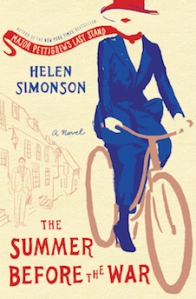
Summer_10_14_redHat_BrokenLine.inddLately I have been reading several books of historical fiction from the era of WWI. I am currently listening to a Maisie Dobbs audio bookhave started a Bess Crawford book on Overdrive, and last night I finished up The Summer Before the War.

The Summer Before the War was a book that I felt improved and was more entertaining and engrossing as it went along. (So much better than one that starts out promising and then the ending disappoints.) It takes place in East Sussex in 1914, in the small village of Rye. The first major event of their summer is the arrival of Beatrice Nash who has come to apply for the position of Latin teacher. Many in the village do not approve of a young woman for this position; especially one that upon arrival turns out to be more attractive than expected.

Beatrice is championed by a prominent woman of the village, Agatha Kent, whose husband works for the Foreign Office. Agatha has two nephews, Hugh, a medical student, and Daniel, a promising poet. Hugh and Daniel have differing personalities but are close and are both adored by Agatha.

When Germany invades Belgium, Rye is quick to welcome refugees and, in spite of those who still believe war won’t come to England, the village prepares to support their country even if it means sending their young men off to war. Soon everyone in the village–the young the old, and all those in between–become caught up in a patriotic fervor. Of course, their young men do go off to war, and what happens to them and the ones who are left to wait for them makes up the rest of the story.

Part of what interests me in reading historical fiction is found at the end in the author’s notes or acknowledgements. Simonson tells of the books she read to immerse herself in this period, as well as the websites and libraries. I love that she was able to read newspapers of the time (and took the trouble to do so).

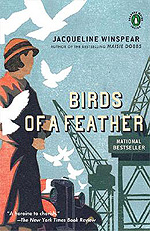
birds-of-a-feather-150For those of you unfamiliar with Maisie Dobbs or Bess Crawford, they are both heroines of their own historical mystery series. The Maisie Dobbs books are written by Jacqueline Winspear and Birds of a Feather is the second in the series. I’m always looking for audio books with good narrators and a story that I can follow as I drive, walk, or cook. So far, this book has delivered with the excellent narration done by Kim Hicks.

The Bess Crawford books are written by the mother/son team, Charles Todd. I have just started reading the second in that series, An Impartial Witness. A group I belong to on goodreads–Historical Mystery Lovers–will be reading a selection of your choice from Charles Todd during July, so I have a bit of a head start. If you’re on goodreads, check out the group and come read with us.cover-impartial-witness

Reading any WWI fiction or nonfiction? Let me know what you’ve read and can recommend.


The Blood of Caesar by Albert A. Bell, Jr.

albert bellBlood of CaesarSmPtThe Blood of Caesar, A Second Case from the Notebooks of Pliny the Younger is the second book in a series of historical mysteries taking place in the Roman Empire in the first century. This particular book is set in the summer of 83 A.D.

The author, Albert Bell has been a history professor, holds a PhD from UNC-Chapel Hill, as well as an MA from Duke, and MDiv from Southeastern Baptist Theological  Seminary. He has been writing since his high school years, first publishing in 1972.

Bell uses historical figures and events to set up his mysteries. The real Pliny the Younger wrote hundreds of letters which are still considered valuable for the time period. Pliny was also an eyewitness to the eruption of Vesuvius in 79 B.C., and Pliny the Elder lost his life there.

In this second book, Pliny is first asked by the emperor Domitian to trace references to an unknown heir of Augustus Caesar from a part of a letter. He is then asked by a friend to look after a young woman whom the friend claims is a relative, but he will give Pliny no details of her family or explain why her life is in danger. It is not long before Pliny’s own life is in danger as he attempts to unravel the two mysteries without offending the emperor.

I enjoy reading historical fiction from all time periods, and reading mysteries in these different eras and locations adds a certain spice to the reading. Working on my own book of historical fiction, I’ve been reading with an eye as to how authors are able to add both historical detail and locale descriptions without overwhelming, or just flat out boring, the reader. Bell does a good job of describing the city of Rome, as well as the surrounding countryside. He has created engaging characters that help a reader understand the time period in which they live. Pliny has a good friend, Tacitus, (another character from history) who provides some humor and serves as a foil to Pliny’s somewhat staid behavior.

I can also recommend the first book in the series, All Roads Lead to Murder.  roads_murder(1) There are three more books in the series, and I’m looking forward to finding them and reading them as well. For my local friends, these first two books are available at both Union County Public Library and Charlotte Mecklenburg Library.


The Architect’s Apprentice by Elif Shafak

20160414_095717

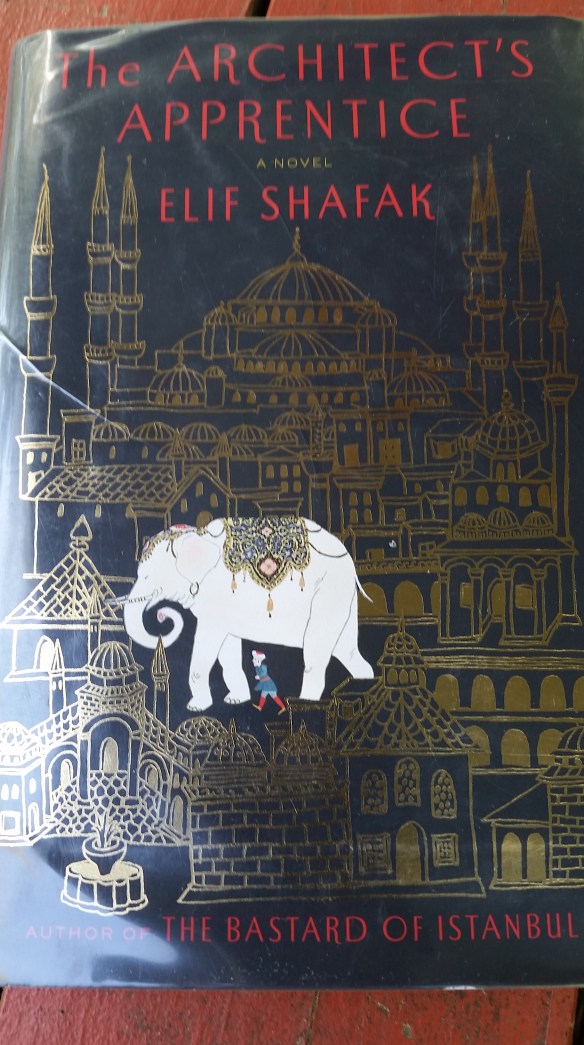
The Architect’s Apprentice is a very engaging and entertaining story which takes place in Istanbul in the 1500’s. The story is told through the eyes of an apprentice to the architect, Mimar Sinan, who designed buildings (mostly mosques, but also bridges) during the Ottoman Empire. Sinan, a contemporary of Michelangelo, was appointed to be the chief royal architect at the age of 50 and kept the post for almost 50 years.

His apprentice (in this story) was an Indian boy, Jahan, who arrived in Istanbul with a white elephant which had been sent as a gift for the Sultan. The city, its politics and intrigues, are seen through Jahan’s eyes as he continues to be the mahout, or keeper of the elephant. He soon catches the eye of Sinan with his own drawings and is made Sinan’s apprentice though he continues his duties as mahout. The white elephant, Chota, is as much an important character as Jahan and Sinan. Chota and Jahan grow up together, serving the Sultan, both in war and in helping with building bridges and mosques, designed by Sinan.

This is a time and place in history which I have not been very familiar with, so that added to my interest for the story. Any other books written about this time period that anyone can recommend? Or other books about the architect, Sinan?