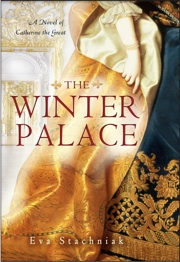
The Winter Palace by Eva Stachniak

St. Petersburg, October, 17, 1756 Three people who never leave her room, and who do not know about one another, inform me of what is going on, and will not fail to acquaint me when the crucial moment arrives.–From the letter of Grand Duchess of All the Russias (later Catherine the Great) to Sir Hanbury-Williams, British ambassador to the court of Empress Elizabeth.

So begins The Winter Palace, an historical novel about Catherine II of Russia, also known as Catherine the Great. Catherine was born as Sophia in Prussia and brought to Russia to marry the nephew of the Empress Elizabeth. This story takes place during the years of 1743-1764 and told through the eyes of a girl who becomes a friend and ‘tongue’ of Catherine. Barbara, or Varvara, is also a  ‘tongue’  (or what we would call a spy) for the Empress Elizabeth.

Stachniak, born in Poland and author of several other historical novels, has written an intriguing and fascinating account of Catherine’s young life. Rich, historical detail give us a picture of the court life of Russia during this time and the constant danger of trusting anyone. Catherine did not become popular overnight and was at the mercy of the Empress Elizabeth. Catherine’s husband, the future Emperor Peter III, was much like a child and as much a pawn for the Empress as was Catherine and the children she bore.  Catherine shows hints of her future greatness as she keeps her wits, makes friends where she needs to, and prepares to take the throne when the time is ripe.    

                                                                                                       The Winter Palace is due to be released in January of next year.

I received this book for free though Goodreads First Reads.
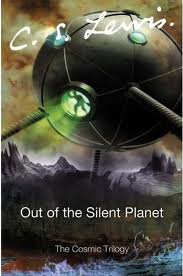
Out of the Silent Planet–C.S. Lewis

Today is the birthday of C.S. Lewis.  I wrote a little about Lewis last week and today want to talk about the first book in his space trilogy, Out of the Silent Planet.

I used this book while teaching literature to some high school students. There are themes running throughout the book such as the value of life, social Darwinism, and the spiritual battle of good & evil which make for very good discussion with this age.

In this trilogy, the main character, Ransom,  seems to be a lot like Lewis himself. He is a professor, an expert in languages and medieval literature, single, and was wounded in WWI, but Lewis always maintained that he fashioned Ransom after his good friend, J.R.R. Tolkien.

In Out of the Silent Planet, Ransom is kidnapped by some scientists who take him to another planet, Malacandra, believing they need him as a sacrifice. Ransom manages to escape after they land & begins to meet the inhabitants of this planet.  Though he is afraid of them at first, he soon learns that they have more intelligence, and certainly are more moral, than the scientists who have kidnapped him. He also discovers that Earth has been exiled from the rest of the solar system due to its fallen nature.

Ransom settles into a routine with these beings and has his ideas about life–mainly, religion and humanity–challenged and questioned. Before he can get too comfortable, though, he is summoned to meet the ruler of  Malacandra. Here, he is challenged still greater about his previous beliefs in God and his own planet, Earth.

Though Lewis was a genius at explaining God & theology in his non-fiction writings, his analogies and allegories are also amazing and thought-provoking throughout his fictional writings.

I used the literature guide from Progeny Press when I taught this book. I highly recommend all of their guides. They divide the book into readable sections with vocabulary and discussion questions. They have several others for books by C.S. Lewis including some of the Narnian Chronicles and The Screwtape Letters and are a Christian-based curriculum.

Happy Birthday, Professor Lewis!

C.S. Lewis

Today marks the day one of Christianity’s greatest writers died in 1963. Lewis’s writings continue to inspire, entertain, & educate over 40 yrs after his death. Lewis is known mainly for his Christian apologetics–an Oxford professor who became a Christian much against his will. His book, Surprised by Joy, tells of his conversion to Christianity. His book, Mere Christianity, is a Christian classic.
Lewis also wrote books that, though for a younger audience, are continuing to entertain all ages. I read his Narnian Chronicles in a literature class in college and used that first book, The Lion, the Witch, and the Wardrobe in a literature class with a homeschooling co-op.
On Lewis’s birthday, 11/29, I will post about another series I used while teaching literature to high school students.

Reinventing Rachel by Alison Strobel

>
I recently read this book & reviewed it on goodreads.com, so thought I would share it here, too.

In Reinventing Rachel , Rachel has been raised a Christian & has spent her youth & college years ‘living for God’. She believes she is doing all the right things & is living the perfect life, so when things begin to fall apart, she is devastated and feels that God has not ‘had her back’. So, she goes to Chicago to start a new life, away from God.Rachel makes new friends and tries a new life-style, but it’s not long before she finds that God is not so easy to get away from.

Strobel does a good job of presenting some normal frustrations and disillusions that some people have when they have their own ideas of how God should be, how He should behave, and how we should be treated by Him; especially if we have done all of the ‘right’ things and been a basically good person.

At first, I didn’t think I would like this book as Rachel was very unlikable in the beginning, giving a negative viewpoint of Christians that is too easy to find in secular fiction. But, as the story progressed, I could understand her struggles & felt she grew as a character in a believable way.

Here is a video introducing the book: www.youtube.com/watch?v=QnHdq371LKc

Shakespearean Teaching Aids I

Shakespeare’s works can be introduced and taught to students of all ages. To get your younger (elementary and middle school) students interested in reading Shakespeare, have them first read some books that will entertain and teach them more about the time period. I will review and suggest some different books in this category over the next few weeks.

Susan Cooper’s King of Shadows is about an American boy, Nat, who is picked to perform with a new acting company who will perform at London’s new copy of the Globe, the theater William Shakespeare performed in. Nat goes to bed sick one night, wakes up well, but finds himself in the 16th century expected to perform at the original Globe with his costar, William Shakespeare.


Reading this book will give students a feel for the theater, the time period Shakespeare lived and performed in, and will introduce them to the play A Midsummer Night’s Dream. A website that contains discussion questions and suggested activities for this book is: http://www.multcolib.org/talk/guides-king.html.